

Complete Guide to Vastu Shastra for Home Buyers
Home buying is one of the most important decisions in life. Along with location, budget, connectivity, and amenities, many Indian homebuyers also consider Vastu Shastra before purchasing a property.
Vastu Shastra is the traditional Indian science of architecture and spatial planning. It focuses on balancing natural forces such as sunlight, air, water, earth, space, and directional energies to create harmonious living environments. While modern architecture emphasizes structural strength and functionality, Vastu adds another dimension by considering the flow of natural and spiritual energies within a property.
This guide summarizes the key Vastu principles that homebuyers should understand before purchasing a plot, villa, independent house, or apartment.
Understanding the Basics of Vastu Shastra
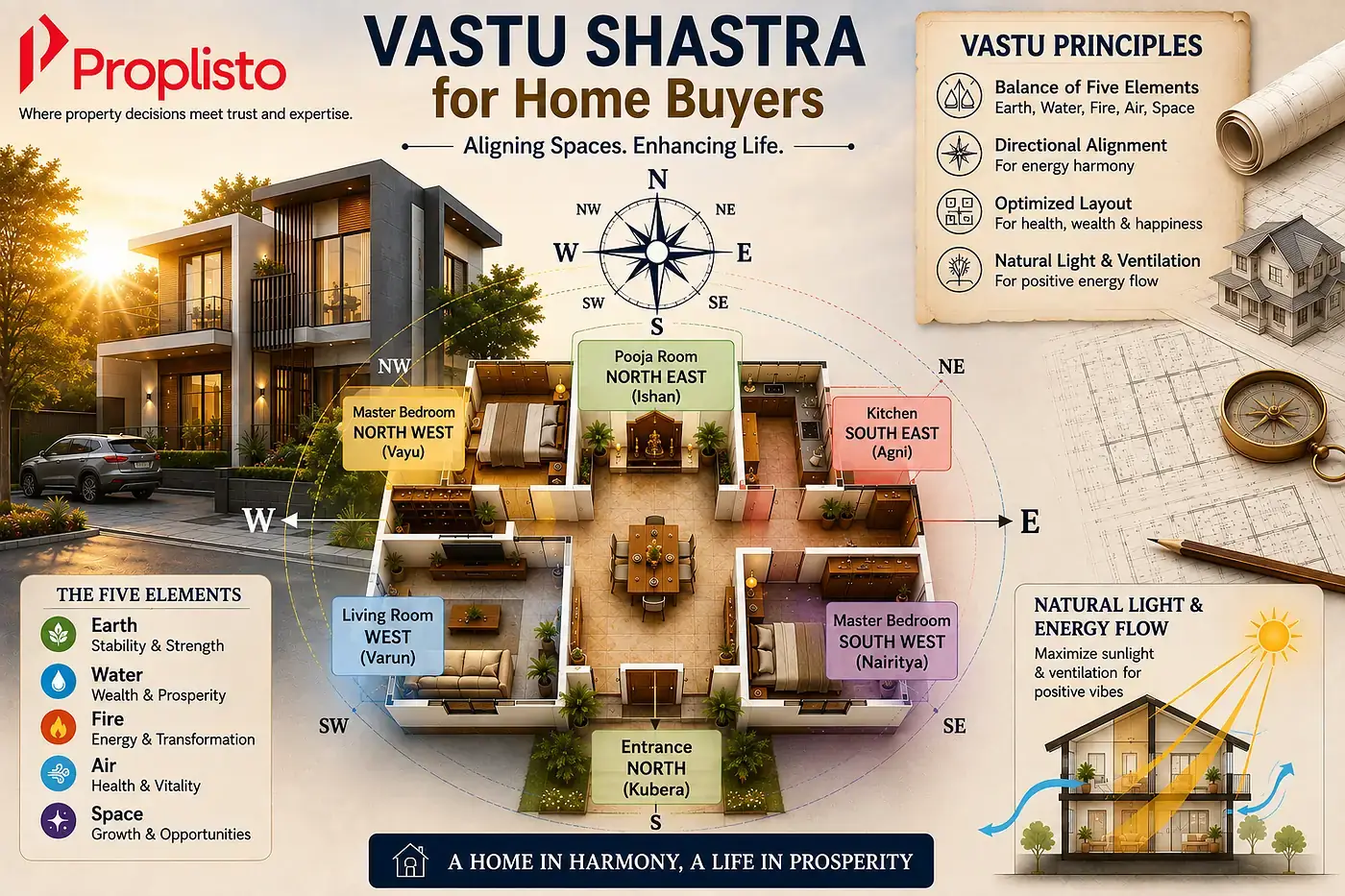
According to traditional Vastu principles, every direction is associated with specific energies and functions. The science is based on the Vastu Purusha Mandala, a geometric layout that divides a property into various zones governed by different forces.
The primary objective of Vastu is to ensure that a home receives adequate sunlight, airflow, positive energy, and proper spatial balance.
However, Vastu should be viewed as a practical guide rather than a rigid rulebook. Modern urban living often requires adaptations, especially in apartments and compact developments.
Choosing the Right Plot
The selection of land is considered one of the most important aspects of Vastu.
Preferred Plot Shapes
The most recommended plot shapes are:
- Square plots
- Rectangular plots
- Octagonal plots (in some traditional interpretations)
These shapes are believed to promote stability and balance.
Plot Shapes to Avoid
Traditionally, the following plot types are considered less favorable:
- Triangular plots
- L-shaped plots
- Highly irregular plots
- Plots with missing corners
A northeast cut corner is considered particularly unfavorable in classical Vastu literature.
Ideal Plot Slope
Vastu recommends:
- Lower levels towards the North or East
- Higher levels towards the South or West
This allows better flow of sunlight, water, and natural energy.
Road Position and Plot Facing
The position of roads around a property plays an important role in Vastu.
Preferred Road Configurations
- Roads on North and East sides
- Roads on all four sides of the plot
- Road ending at the Northeast corner
These configurations are traditionally considered beneficial.
Direction of the Plot
Different plot-facing directions are associated with different occupations:
- East-facing: Suitable for teachers, scholars, and professionals
- North-facing: Suitable for administrators and government-related professions
- South-facing: Considered suitable for business activities
- West-facing: Suitable for service-oriented professions
Contrary to popular misconceptions, traditional Vastu does not completely reject west-facing properties.
Important Vastu Considerations Before Buying a Home
Check the Surroundings
Homebuyers should evaluate:
- Nearby temples, hospitals, factories, and commercial structures
- High-rise obstructions on the North, Northeast, or East
- Presence of large pits or depressions
- Electrical installations near the Northeast zone
Open spaces towards the North and East are generally preferred.
Water Sources
According to Vastu:
- Wells, borewells, lakes, or water bodies are ideally placed in the North or Northeast.
- Water bodies in the Southwest are generally discouraged.
Vastu for Main Entrance
The entrance is considered one of the most important elements of a house.
Recommended Practices
- Main door should be larger than other doors.
- Door should open inward.
- Entrances on North and East sides are generally preferred.
- Entrance should be well-lit and unobstructed.
Avoid
- Direct obstructions such as large trees or poles in front of the entrance.
- Underground tanks below the entrance area.
- Main doors exactly facing another main door.
Ideal Room Placement According to Vastu
Master Bedroom
Best locations:
- Southwest
- Northwest
The Southwest zone is generally considered the most suitable for the head of the family.
Children's Bedroom
Preferred locations:
- West
- Northwest
- East
Kitchen
The Southeast direction is traditionally regarded as the ideal location for the kitchen because it represents the fire element.
Pooja Room
The most auspicious location is:
- Northeast corner
The prayer area should be peaceful, clean, and separate from bathrooms.
Living Room
Preferred locations:
- North
- East
These directions are associated with openness and positive energy flow.
Bathrooms and Toilets
Traditionally recommended locations:
- West
- Northwest
Bathrooms in the Northeast zone are generally avoided.
Vastu Guidelines for Open Spaces and Landscaping
A well-planned outdoor area is considered beneficial in Vastu.
Recommended
- Gardens in North, East, or Northeast
- Tulsi plant in North or East
- Small plants in Northeast areas
- Large trees in South or West
Avoid
- Thorny plants near the house
- Large trees blocking sunlight on the East side
- Heavy landscaping in the Northeast corner
Water Tanks and Staircases
Overhead Water Tanks
The preferred location is:
- Southwest corner
- West side
Staircases
Best locations include:
- Southwest
- South
- West
The Northeast zone is generally avoided for staircases.
Vastu for Apartments and Modern Homes
In today's cities, many homebuyers live in apartments where complete compliance with every Vastu guideline may not be possible.
Traditional Vastu texts themselves acknowledge that ideal conditions are not always achievable. Therefore, homebuyers should focus on practical aspects such as:
- Good ventilation
- Natural sunlight
- Proper room functionality
- Clean surroundings
- Balanced space planning
These factors often contribute more to comfort and quality of life than strict adherence to every traditional rule.
Common Vastu Myths Home Buyers Should Know
Myth 1: West-Facing Homes Are Bad
Traditional Vastu literature does not completely prohibit west-facing homes. Proper planning and layout remain more important.
Myth 2: Every Vastu Defect Causes Problems
Many Vastu principles were created based on practical considerations such as sunlight, drainage, ventilation, and safety.
Myth 3: Apartments Cannot Follow Vastu
While apartments may not achieve perfect Vastu compliance, many important principles can still be incorporated.
Conclusion
Vastu Shastra remains an important consideration for many Indian homebuyers. Whether purchasing a plot, villa, independent house, or apartment, understanding the basic principles of plot selection, directional planning, room placement, and entrance positioning can help you make a more informed decision.
However, homebuyers should balance Vastu recommendations with practical factors such as location, legal approvals, construction quality, connectivity, builder reputation, and overall lifestyle needs. A well-designed home that offers comfort, safety, and functionality will always be the most valuable investment.