

Bangalore Real Estate: Past, Present, and Future of India's Most Dynamic Property Market
Bangalore Real Estate: Past, Present & Future
Bangalore has transformed into one of India's most influential real estate destinations. Once celebrated as the Garden City, it is now recognized globally as the country's technology capital and one of the fastest-growing property markets. The city's real estate journey reflects its economic evolution—from public sector industries and research institutions to IT parks, startups, Global Capability Centers (GCCs), and world-class infrastructure.
Today, Bangalore attracts homebuyers, investors, developers, and multinational corporations alike. Strong employment opportunities, continuous infrastructure development, and expanding residential corridors continue to drive demand across the city.
In this article, we explore Bangalore's real estate journey through its past, present, and future.
The Past: From Garden City to Industrial Hub
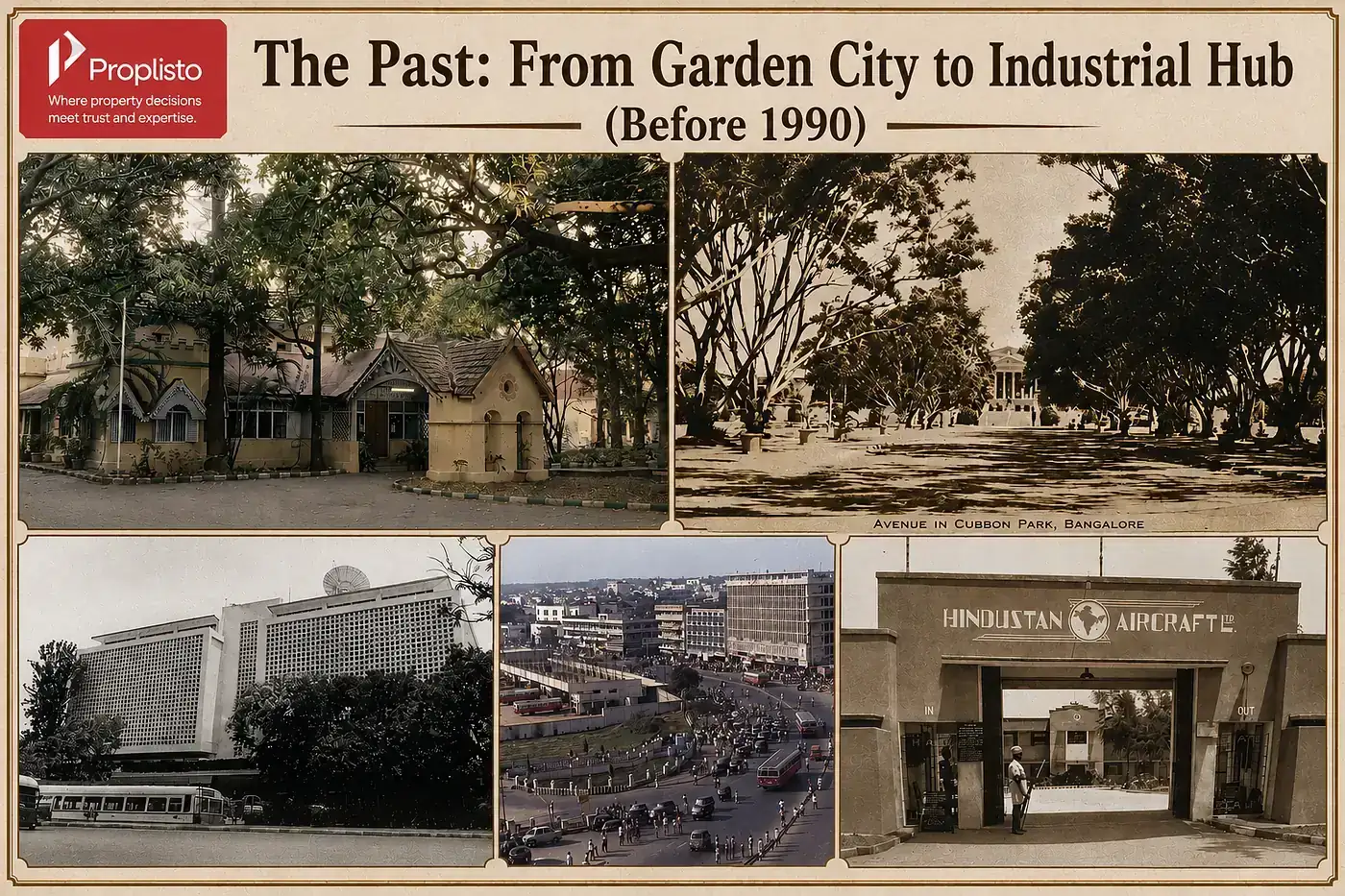
Before the IT revolution, Bangalore was widely known as the Garden City of India. The city featured tree-lined avenues, beautiful lakes, spacious bungalows, and well-planned residential neighborhoods. During this period, real estate demand remained moderate as urban expansion was relatively limited.
Major Growth Drivers
- Public Sector Undertakings (PSUs) such as HAL, BEL, BEML, and HMT
- Defence and aerospace industries
- Indian Institute of Science (IISc) and other educational institutions
- Government research organizations
Independent houses, plotted developments, and low-rise residential neighborhoods dominated the market. Some of the city's most sought-after localities included:
- Basavanagudi
- Jayanagar
- Malleswaram
- Rajajinagar
- Indiranagar
As industrial activity expanded, areas such as Peenya, Whitefield, and Yelahanka gradually witnessed new development.
The IT Revolution (1990–2010)
Economic liberalization in the early 1990s changed Bangalore forever. The arrival of multinational technology companies, along with the growth of Indian IT giants like Infosys and Wipro, transformed the city into India's Silicon Valley.
Several landmark developments accelerated this transformation:
- Electronic City
- International Tech Park Bangalore (ITPB), Whitefield
- Outer Ring Road IT Corridor
- Expansion of major software campuses
The rapid creation of employment attracted professionals from across India, leading to an unprecedented increase in housing demand.
Developers responded by launching:
- Gated communities
- Premium apartment projects
- Luxury villas
- Commercial office parks
- Integrated townships
Major residential growth shifted towards:
- Whitefield
- Electronic City
- Sarjapur Road
- Bellandur
- Marathahalli
- HSR Layout
Housing demand became closely linked with employment hubs, laying the foundation for Bangalore's modern real estate market.
The Present: Bangalore's Mature Real Estate Market
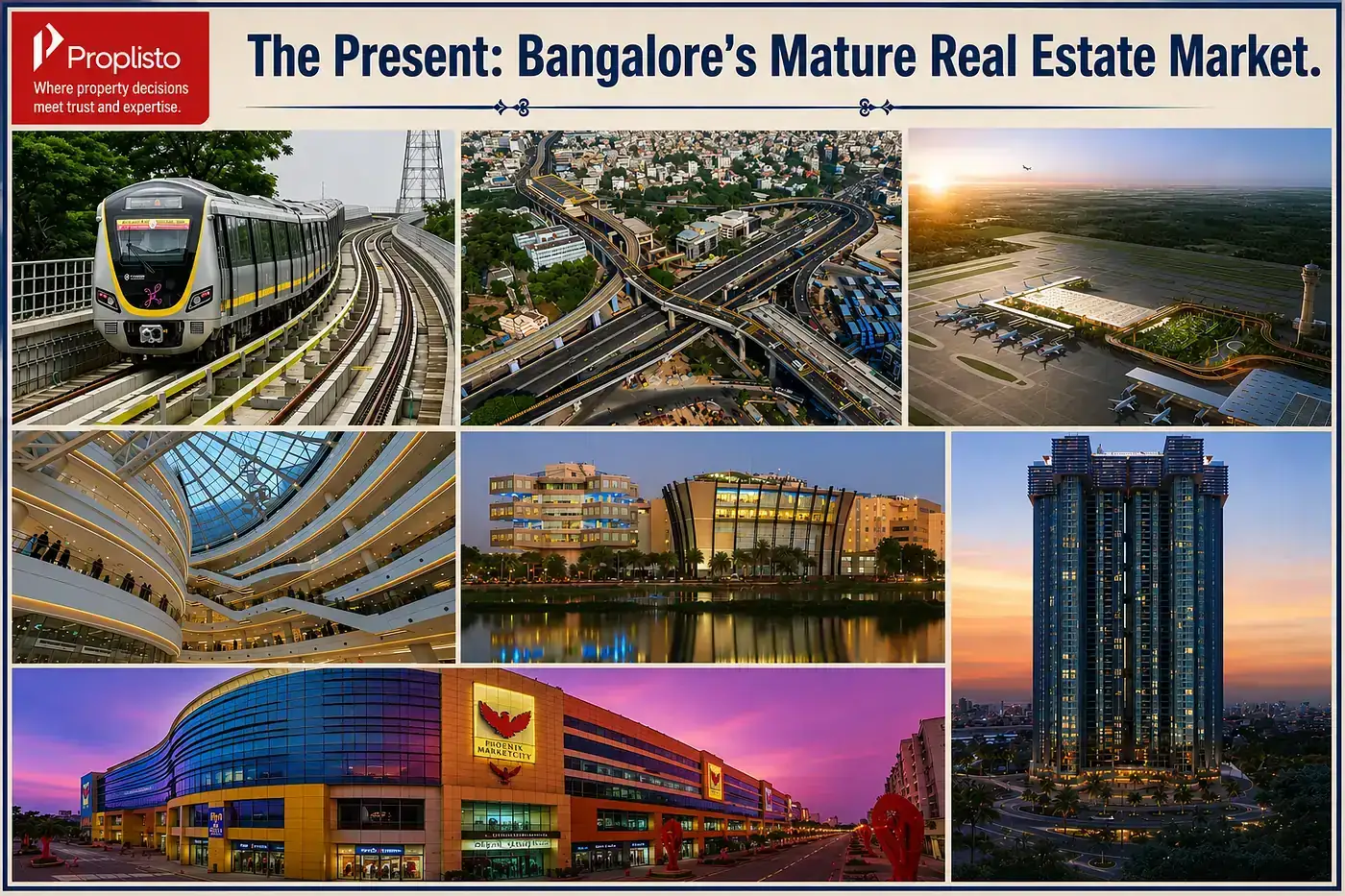
Today, Bangalore is one of India's strongest residential and commercial property markets. Demand continues to remain healthy due to a combination of employment growth, infrastructure development, and lifestyle-driven housing preferences.
Strong Employment Growth
Bangalore hosts thousands of companies across sectors including:
- Information Technology (IT)
- Global Capability Centers (GCCs)
- Artificial Intelligence (AI)
- Biotechnology
- Semiconductor manufacturing
- Aerospace
- Startups
A continuous inflow of skilled professionals supports long-term housing demand.
Infrastructure Expansion
Major infrastructure projects are reshaping the city's connectivity:
- Namma Metro expansion
- Peripheral Ring Road (PRR)
- Satellite Town Ring Road (STRR)
- Suburban Rail Project
- Airport connectivity improvements
- Elevated corridors
These developments are unlocking new residential and commercial investment opportunities across emerging micro-markets.
Rise of Multiple Growth Corridors
Rather than expanding from a single city center, Bangalore now grows through multiple thriving corridors.
East Bangalore
- Whitefield
- Varthur
- Sarjapur Road
- Kadugodi
North Bangalore
- Hebbal
- Yelahanka
- Thanisandra
- Devanahalli
South Bangalore
- Electronic City
- Bannerghatta Road
- Kanakapura Road
West Bangalore
- Kengeri
- Mysore Road
- Magadi Road
Each corridor now offers a complete ecosystem of schools, hospitals, shopping destinations, and employment centers.
Lifestyle-Oriented Housing
Modern homebuyers increasingly prioritize lifestyle amenities over basic housing.
Popular features include:
- Clubhouses
- Swimming pools
- Landscaped gardens
- Co-working spaces
- Sports facilities
- Smart home technology
- EV charging stations
- Green-certified buildings
Lifestyle and convenience have become major decision-making factors for buyers.
The Future of Bangalore Real Estate
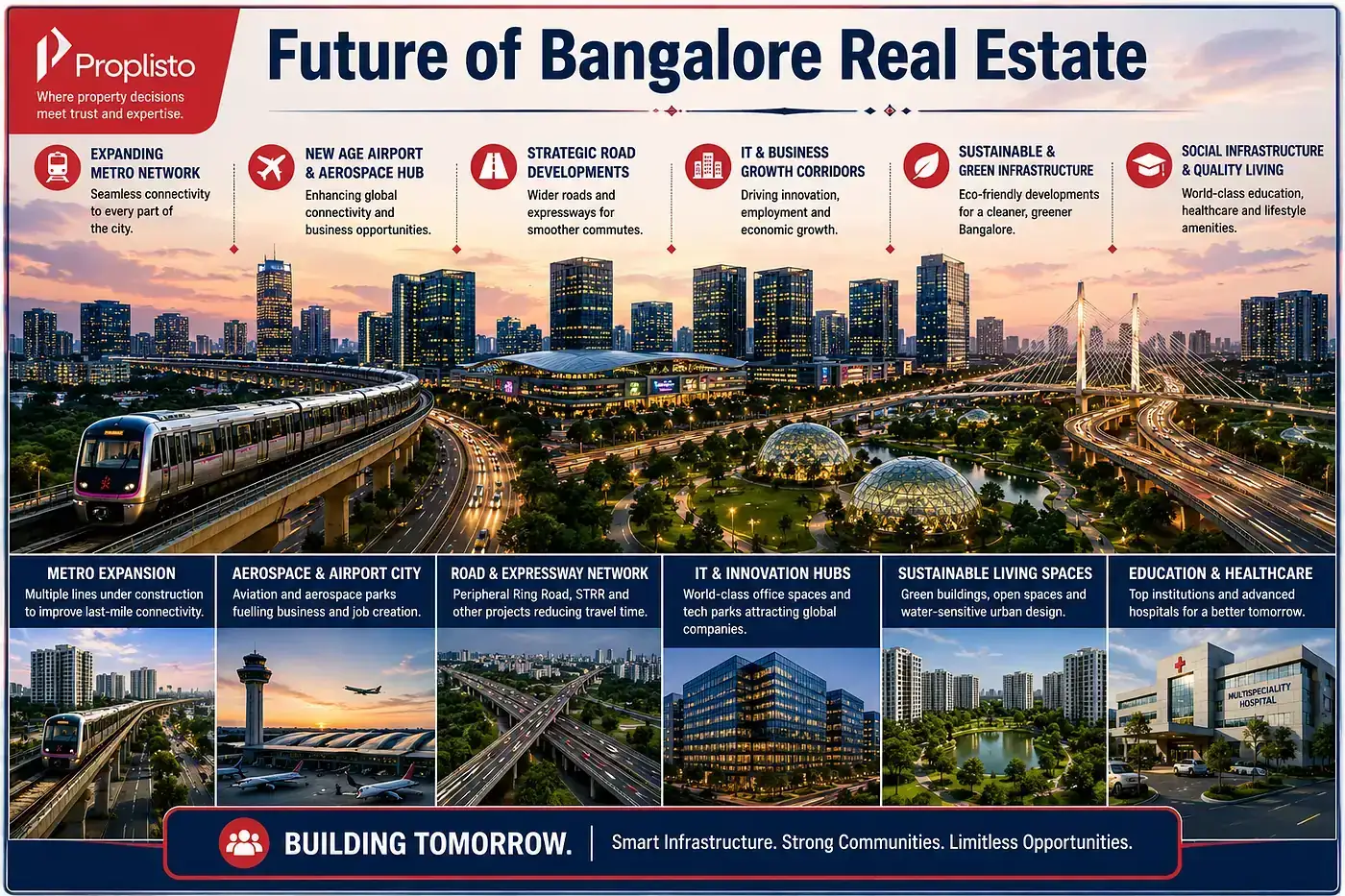
Bangalore's property market is expected to witness another phase of transformation over the coming decade.
Metro-Oriented Development
As the Namma Metro network expands, residential and commercial developments are expected to cluster around metro stations, improving connectivity and reducing commute times.
Airport-Led Growth
North Bangalore continues to emerge as one of the city's strongest investment destinations due to:
- Kempegowda International Airport
- Aerospace Park
- Business parks
- Logistics hubs
- Upcoming Metro connectivity
This region is expected to remain a preferred destination for both residential and commercial developments.
Expansion of Peripheral Locations
Areas such as:
- Devanahalli
- Hoskote
- Sarjapur Extension
- Anekal
- Doddaballapur Road
are attracting increasing attention because of affordable land prices and upcoming infrastructure projects.
Sustainable Development
Developers are placing greater emphasis on environmentally responsible construction through:
- Rainwater harvesting
- Solar energy
- Water recycling
- Green-certified buildings
- Smart energy management
- Eco-friendly construction materials
Sustainability is expected to become a key differentiator in future projects.
Technology-Driven Real Estate
Digital innovation is reshaping the industry through:
- AI-powered property recommendations
- Virtual property tours
- Digital documentation
- Blockchain-based records
- Data-driven property pricing
Technology will continue to simplify property buying, selling, and management.
Challenges Ahead
Despite its impressive growth, Bangalore's real estate market faces several challenges:
- Traffic congestion
- Water availability
- Rising land prices
- Infrastructure keeping pace with growth
- Environmental sustainability
- Housing affordability in premium locations
Addressing these issues will be essential for maintaining long-term growth and livability.
Why Bangalore Continues to Attract Investors
Bangalore remains one of India's most resilient real estate markets due to its strong economic fundamentals.
Key advantages include:
- Consistent employment generation
- High rental demand
- Continuous infrastructure investment
- Global corporate presence
- Strong end-user demand
- Thriving startup ecosystem
- Long-term capital appreciation potential
Unlike speculative markets, Bangalore's property sector continues to be driven largely by genuine housing demand created by professionals, businesses, and expanding industries.
Frequently Asked Questions (FAQs)
1. Why is Bangalore considered one of India's best real estate markets?
Bangalore is driven by a strong IT and startup ecosystem, Global Capability Centers (GCCs), multinational companies, and continuous infrastructure development. These factors create steady demand for residential and commercial properties, making the city a preferred destination for both homebuyers and investors.
2. Which areas in Bangalore have the highest real estate growth potential?
Some of the fastest-growing locations include Whitefield, Sarjapur Road, Electronic City, Hebbal, Thanisandra, Yelahanka, Devanahalli, and Hoskote. These areas benefit from expanding infrastructure, Metro connectivity, and proximity to major employment hubs.
3. How has Bangalore's real estate market evolved over the years?
Bangalore transitioned from a peaceful Garden City with independent homes and plotted developments to India's technology capital. The IT boom in the 1990s fueled rapid urbanization, leading to the growth of gated communities, luxury apartments, integrated townships, and large commercial office spaces across the city.
4. What factors will shape the future of Bangalore's real estate market?
The future of Bangalore real estate will be influenced by Metro expansion, airport-led development in North Bangalore, the Peripheral Ring Road (PRR), the Satellite Town Ring Road (STRR), the Suburban Rail Project, sustainable construction practices, and increasing adoption of smart technologies in real estate.
5. Is Bangalore a good city for long-term real estate investment?
Yes. Bangalore has consistently demonstrated strong long-term appreciation due to its growing employment opportunities, high rental demand, expanding infrastructure, and continuous influx of professionals. These fundamentals make it one of India's most stable and attractive property investment markets.
6. What challenges does Bangalore's real estate market face?
Despite its growth, Bangalore faces challenges such as traffic congestion, water resource management, rising land prices, infrastructure keeping pace with urban expansion, and maintaining environmental sustainability. Addressing these issues will be essential for the city's continued real estate growth.